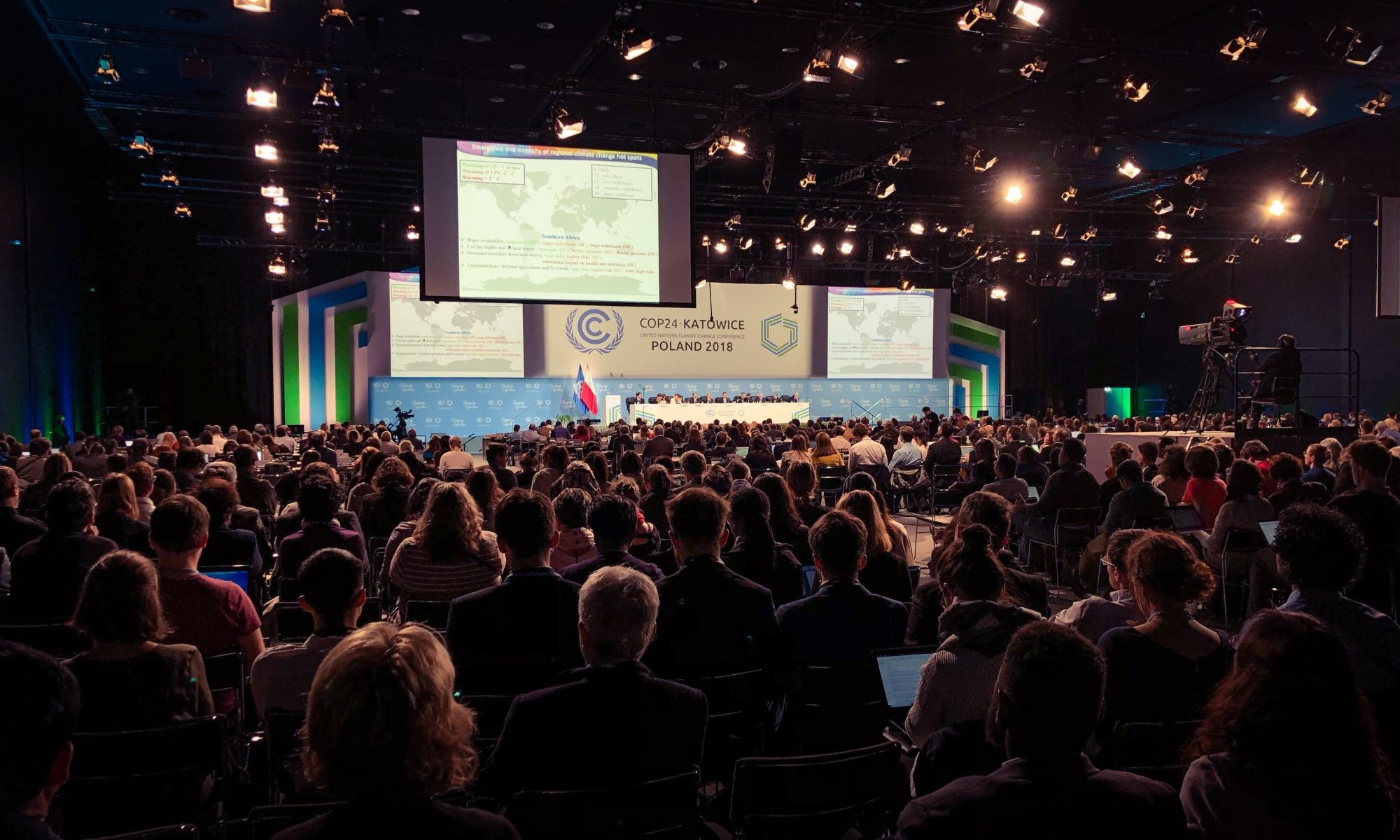

This piece was originally published in 2019 as a comment on the COP24 round of UN Climate Change negotiations in Katowice, Poland. It is republished here in recognition of the fact the pervasive and costly climate impacts are now affecting all regions, and amid controversy over whether the COP29 outcome will deliver financial resources and policy support for climate-resilient development at the levels required.
The Day the World Stood Still
During the 2018 United Nations Climate Change negotiations (the COP24), co-chairs of the Intergovernmental Panel on Climate Change presented the latest scientific findings about what would happen if the world warms by 1.5ºC on average above pre-industrial levels. It was a special plenary session, meaning every nation was represented, as well as every international agency, and as many observers as could fit. What happened in that room was powerful, unique and worth remembering. Usually, the plenary session is a constant buzz of chatter and activity.
- Individual nations and multinational negotiating groups speak for roughly 3 minutes each.
- Facilitators chairing the meeting generally manage the list of speakers, but also sometimes add critical insights about the substance of the negotiations or try to steer the room toward consensus.
- People constantly come and go, and everyone is busy typing or talking to someone next to them.
- The stakes are high, and everyone has a job to do, and a vast constituency outside the room which they represent.
In the Special Plenary on the IPCC’s Special Report on Global Warming of 1.5ºC, there was a deep and prolonged silence and virtually no one milled around or walked out. If you haven’t been in one of these negotiations, it is hard to express how unusual that was. In my experience, it was totally unprecedented. It almost felt like New York’s Grand Central Station had, in a matter of minutes, been converted into a temple where everyone stopped rushing around and sat down to meditate.

Thousands of people whose job is to negotiate a global strategy for solving climate change sat silent and awe-struck, as they listened to harrowing details of what will happen (what is already happening) to vital ecosystems, watersheds and weather patterns, and to specific regions around the world.
- Most of these people would have already read the Summary for Policy-Makers and significant additional details of the report.
- The most worrying headlines had been circling the world for weeks.
- And yet, the room was overtaken by an awed and solemn silence.
This stunned silence was not, I think, from surprise or astonishment. It seemed, rather, a solemn recognition, by the diplomats, scientists, economists, and advocates gathered in that room, that this was a shared mission, that it could very well elude our best efforts at collaborative innovation, and that — above all — failure is not an option.

The report was mandated by the Paris Agreement, in order to determine whether 1.5ºC is a more scientifically appropriate measure of “dangerous interference”, which the 1992 treaty requires we work together to avoid. It is clear from the findings of the report that warming beyond 1.5ºC is too dangerous, costly, and complicated to allow for the kind of prosperity we aspire to. Failure in our collective response is not an option. The silence in that room seemed to be a response to the transcendent meaning of the moment, hearing in the scientific findings what Rachel Carson said during a 1962 commencement address:
You must face realities instead of taking refuge in ignorance and evasion of truth. Yours is a grave and sobering responsibility, but it is also a shining opportunity. You go out into a world where mankind is challenged, as it has never been challenged before, to prove its maturity and its mastery — not of nature, but of itself. Therein lies our hope and our destiny.
Now nearly halfway through 2019, 70 percent of the way from the Paris Agreement to the critical 2020 climate negotiations, that grave and sobering responsibility requires rapid acceleration of coordinated efforts to:
- Deliver affordable clean energy to all people, in all economic conditions, in all regions.
- Mainstream climate-smart finance, with new, interactive metrics, blended sourcing, and decentralizing instruments.
- Spread regenerative practices through large and small farming, industry and enterprise.
- Accelerate adaptation, so communities, economies, institutions, and nations can avoid cost and build resilient prosperity.
- Align policies at local, national and international levels with the 1.5ºC upper limit for global heating.
The action response to that moment of solemn recognition is to work together, with all deliberate speed, to meet the moment, empower each other, decentralize power and influence, innovate at record pace, and include more people than ever in big, future-building decisions. We must align better, and go faster.
UPDATE—November 25, 2024
A note on climate law
The United Nations Framework Convention on Climate Change calls on all countries to work together to “prevent dangerous anthropogenic interference with the climate system”. It also calls for reducing global heating emissions to 1990 levels, globally, no later than the year 2000.
The Convention is a ratified treaty and constitutes both national and international law for nearly 200 countries.
As of November 2024, global heating emissions continue to rise, and costly climate impacts are affecting all regions, and getting worse. Neglecting to honor the law does not change the law; all nations have an obligation to participatae in a cooperative effort to avoid catastrophic climate breakdown.
For many countries, this means destabilizing drought and food scarcity, already happening now. For others, it is a question of whether institutions and industries can function optimally as impacts proliferate.

Paragraph 1 of Article 2 of the Paris Agreement (Article 2.1) sets a global temperature goal with the following language:
This Agreement, in enhancing the implementation of the Convention, including its objective, aims to strengthen the global response to the threat of climate change, in the context
of sustainable development and efforts to eradicate poverty, including by:a. Holding the increase in the global average temperature to well below 2 °C above preindustrial levels and pursuing efforts to limit the temperature increase to 1.5 °C above pre-industrial levels, recognizing that this would significantly reduce the risks and impacts of climate change;
b. Increasing the ability to adapt to the adverse impacts of climate change and foster climate resilience and low greenhouse gas emissions development, in a manner that does not threaten food production; and
c. Making finance flows consistent with a pathway towards low greenhouse gas emissions and climate-resilient development.
Each of the words of Article 2.1 has saliency. What this means is that finance flows and other pursuits of economic development must align with the Convention mandate to prevent danger and with the aim of achieving climate resilience.
The COP29 decision on the global climate finance goal recites the text about “well below 2ºC”, so it must be noted: The state of climate law is that all nations are bound to contribute to a global project of limiting average temperature rise to no more than 1.5ºC, given the gravity of the dangers now understood to come with such heating.
OUR COP29 COVERAGE


Something went wrong. Please refresh the page and/or try again.